
I don’t know if this needs to be said, but I’m going to say it anyway: never trust a Treasury forecast, or for that matter a forecast produced by any government agency. Their first priority is not objectivity; it’s not pissing off the relevant minister.
That means towing a political line, not an economic one. It means subtly changing methodology mid-way through a series (Table 1, row 6) and hoping no one will notice, all to avoid a politically inconvenient result during union wage negotiations.
It means taking unrealistic assumptions and making projections about the future that are almost certainly false, as the Treasury department did with its recent modelling of Australia’s Net Zero Transformation.
Here are the scenarios, quoted verbatim:
- Baseline: Australia builds on existing climate and energy policies, to achieve emissions reduction targets and net zero by 2050 via an orderly and efficient transition pathway.
- Renewable Exports Upside: Australia follows the same domestic transition pathway as the Baseline Scenario but is additionally successful at leveraging its comparative advantages in renewable energy to capture a larger share of growing global demand for clean energy embedded products.
- Disorderly Transition: Australia delays further climate action, resulting in increased costs over time from a transition path that is more uncertain and disorderly.
Reasonable scenarios. But what’s not mentioned until later is that all three contain a key assumption that the rest of the world takes “mitigation action” that will keep global temperatures “below 2°C by the end of this century”.
Basically, the IEA’s Announced Pledges scenario, which Treasury references and:
“…includes all recent major national announcements as of the end of August 2024, both 2030 targets and longer-term net zero or carbon neutrality pledges, regardless of whether these announcements have been anchored in legislation or in updated Nationally Determined Contributions.”
In chart form, it’s the grey line in the below:
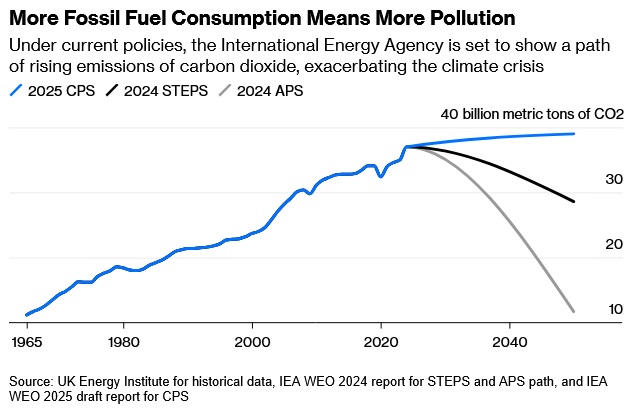
See the problem? It’s not just assuming a slowing in the rate of growth, or a moderate decline in emissions. It’s showing a complete collapse in fossil fuel usage that is extremely unrealistic in a world where China and India intend to build new coal plants until at least 2027—and probably much longer.
It exists in the same world where just 11.9% of coal plants are planned to be phased out in-line with the Paris Agreement, and we in Australia know all too well how difficult that is to achieve in practice. A world where Trump is effectively banning wind power; a world where even Canada’s centre-left government scrapped its carbon tax and is actively expanding its LNG facilities.
In other words, it’s not a reasonable assumption for any kind of “baseline” scenario modelling, and it most certainly should not be used to underpin serious policy decisions that will affect the lives of all Australians for many years to come.
If Treasury was serious about modelling Australia’s Net Zero Transformation, then it should have created a scenario using a range of assumptions about global carbon abatement. For example, the IEA’s draft 2025 outlook contains a scenario based on current policies, showing that global oil and gas use will continue to climb for decades (blue line in the chart above).
How might Australia’s “decisive action on climate change” look with those assumptions underpinning the same modelling scenarios above? Pretty foolish, I’d imagine.
To be clear, that scenario is probably just as poor a projection for how the world will look in 2050. But the whole point of doing scenario analysis is to cover a range of possibilities, not to support a preconceived political agenda.
Unfortunately, at least in this case the Treasury department has clearly undertaken a political rather than economic modelling exercise, and its results—including the hyperbolic suggestion that the value of Australia’s coal and gas exports will plunge 50% in five years—should be discounted accordingly. As the saying goes, garbage in, garbage out. Best to toss this report in the trash where it belongs.