
The government of New South Wales is building a rail link to its new airport out in Western Sydney, “at a combined cost of $19bn to the federal and NSW governments”.
Everyone seems to like rail. As someone who gets motion sickness, I personally much prefer a stable train ride to a wobbly bus. But I also wonder whether people would like it so much if they were aware of the true costs. Not just the up-front infrastructure costs, but the often-significant ongoing operational costs.
The fact is Australia isn’t as dense as places like Hong Kong or Tokyo. That limits the viability of airport rail: most people live in suburbs, not the city. That means rail links alone are unlikely to get many them close to where they need to go, necessitating a time-consuming bus or taxi transfer, which reduces ridership and the economics of the whole enterprise.
If you don’t believe me, let me give you an example. The most recent Australian airport rail line was completed in Perth, Western Australia. The Public Transport Authority (PTA) runs an airport train 7 days a week along the existing route between Claremont and Perth, and then on the existing line to Bayswater, where an expensive tunnelling exercise was undertaken. Ultimately, three new stations were created: Redcliffe, Airport Central, and High Wycombe.
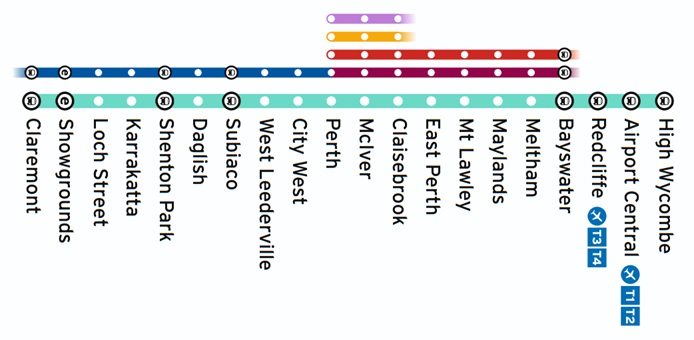
Three years after its launch, how successful has it been? All we know is that overall, users of the state’s buses, trains and ferries received an effective subsidy in 2023-24 that averaged $550 per resident, or around $11 per trip—more than double the maximum fare. The airport line’s subsidy per trip is likely significantly higher given its lower utilisation (see below), but the PTA doesn’t publish route-specific figures.
But we also know the ridership of the airport line—well, sort of. In 2024-25, there were 5,619,693 total boardings across the airport line, which includes people commuting on the existing rail network. For example, someone going to work from Claremont to Perth would be completely indifferent as to whether they boarded the regular ‘blue’ Fremantle or ’teal’ Airport line. The trains are identical and fares are the same, so commuters simply board whichever arrives first. Therefore, many of the recorded “boardings” are not actually people using the line to go to the airport at all.
Still, let’s assume they are. The Airport line runs every 12, 15, or 30 minutes in both directions, depending on the time and day. That adds up to 55,688 trips a year:
249 weekdays * 158 trains
52 Saturdays * 152 trains
63 Sundays and public holidays * 134 trains
= 55,688 trains
That means there’s an average of 101 people on each Airport line train, each of which has a capacity of 240 seated and 320 standing, or 560 people.
So, even if we count every single boarding on the line as an airport trip—which likely vastly overstates actual airport usage—the capacity utilisation of the Perth airport line after three years is still below 20%. If, as I suspect, only a small fraction of uses are actually going to the airport, the capacity utilisation of the airport link section could well be under 5-10%.
I understand the appeal of rail. But these things more often than not turn out to be expensive white elephants that will never come close to paying off the initial investment, let alone the ongoing operating costs that keep getting inflated because politicians can’t help imposing price caps as ‘cost of living’ support for urban upper-middle income earners. But all that does is further obfuscate the true costs, adding to the state’s debt burden, making us all worse off in the future.
Are buses, taxis and rideshares really that bad?